
Volteras Team

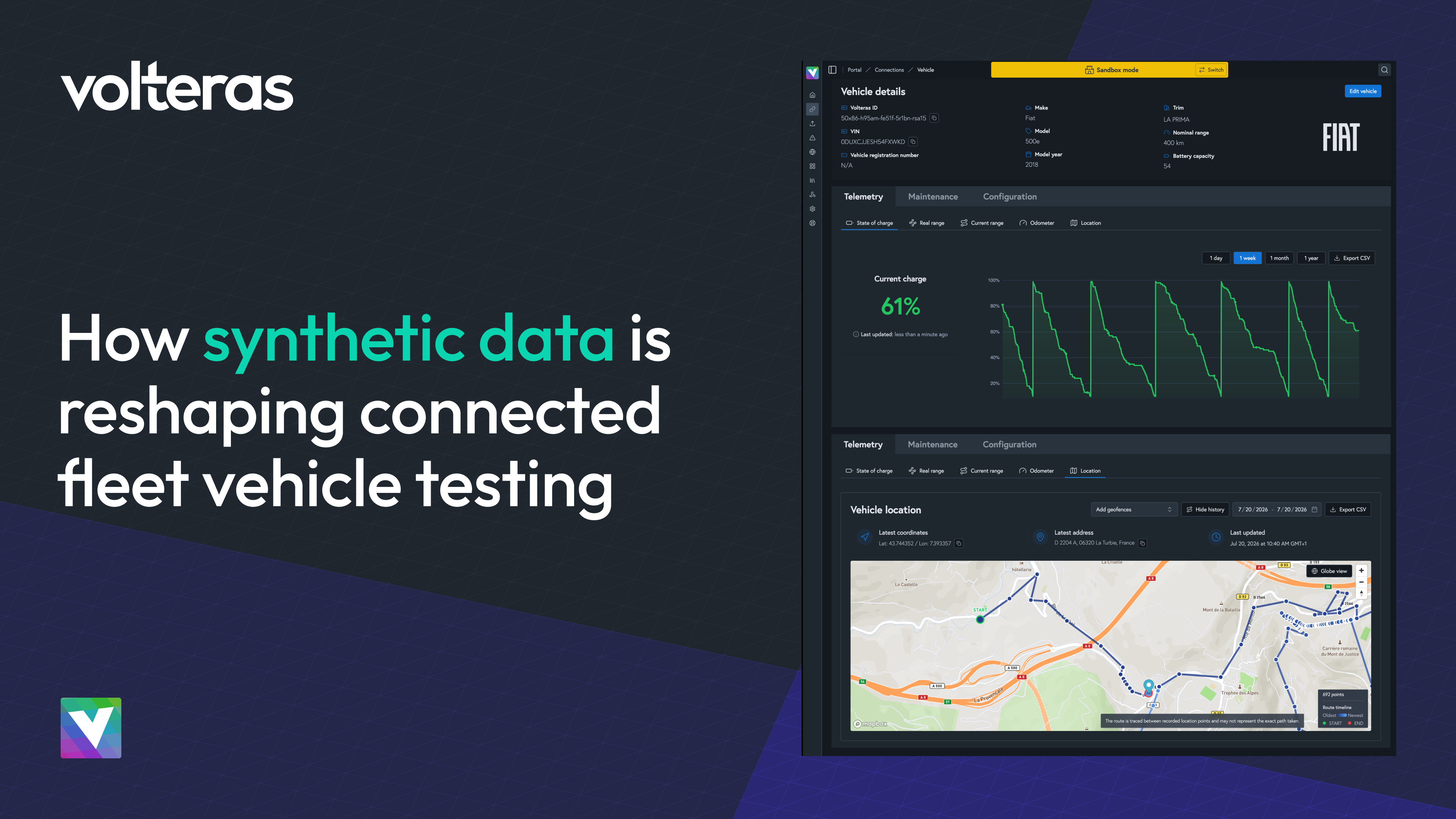
Volteras's synthetic data platform lets fleet customers test connected EV integrations without demo vehicles — using realistic simulated telemetry to speed up the path to full deployment.
Volteras removes one of the biggest barriers to connected fleet integration,
with a synthetic data platform that eliminates the need for long and costly
demo fleet vehicle testing.
Before connected vehicle platforms can be fully adopted, fleets need to
understand how the data behaves in practice. This has typically meant waiting
for demo vehicles to be sourced and driven long enough to generate
meaningful telemetry. Synthetic data, however, gives fleets a clear view of how
connected EV data behaves before live vehicles are introduced to the company
choice list.
By using synthetic data, Volteras can replicate real-world vehicle behaviour
instantly through its state-of-the-art sandbox platform, removing the delay
entirely.
In the sandbox, fleet customers can access a range of virtual electric vehicles
of different makes and models. These are synthetic vehicles that exist entirely
within the platform and are designed to generate the same type of telemetry
you would expect from a real Volteras connected EV.
Once selected, the vehicles are placed into a simulated environment based in
Monaco, where they drive continuously through traffic. The simulation
includes realistic driving behaviours such as stopping at traffic lights,
navigating congestion, and stopping at charging points.
As the synthetic EVs move through the simulation, they produce continuous
streams of data that mirror what a connected fleet would generate in reality.
Odometer readings increase as vehicles travel, state of charge decreases
during driving and increases again during charging events, and when the
simulated EV’s battery gets low, it automatically goes to a charging station,
charges back up, and then continues driving again. Location history builds up
over time, creating a full record of activity.
This allows customers to interact with the Volteras API as if they are already
running a live EV fleet, without needing any physical vehicles in place.
The sandbox is also an ideal environment to explore Volteras’ custom alerts,
which can be attached to any endpoint in the platform. Alerts can be
configured to trigger when a vehicle crosses a geofence threshold or
approaches a mileage limit, allowing fleet managers to validate their alerting
logic against realistic synthetic telemetry before any real vehicles are
connected.
Instead of waiting for EVs to be deployed and driven, customers can
immediately begin querying the API, observing how telemetry changes over
time and understanding how the information fits into their own systems.
Because the sandbox runs continuously, it provides a clear view of how data
evolves across different time intervals rather than relying on short test cycles.
Though the sandbox is not designed to simulate battery degradation, payload
effects or environmental conditions such as weather, it focuses on producing
structured and realistic telemetry that reflects how a connected EV system
behaves from a data perspective.
With the sandbox, Volteras gives fleets and partners a faster, clearer path from
early testing to full EV deployment, without the delays that have traditionally
held the industry back.
Access our exclusive whitepapers, expert webinars, and in-depth articles on the latest breakthroughs and strategic implications of advanced automation and AI.

.jpg)